Webinar II - Representation of Contemporary Georgian Art outside of Georgia, State Influence, and International Reception
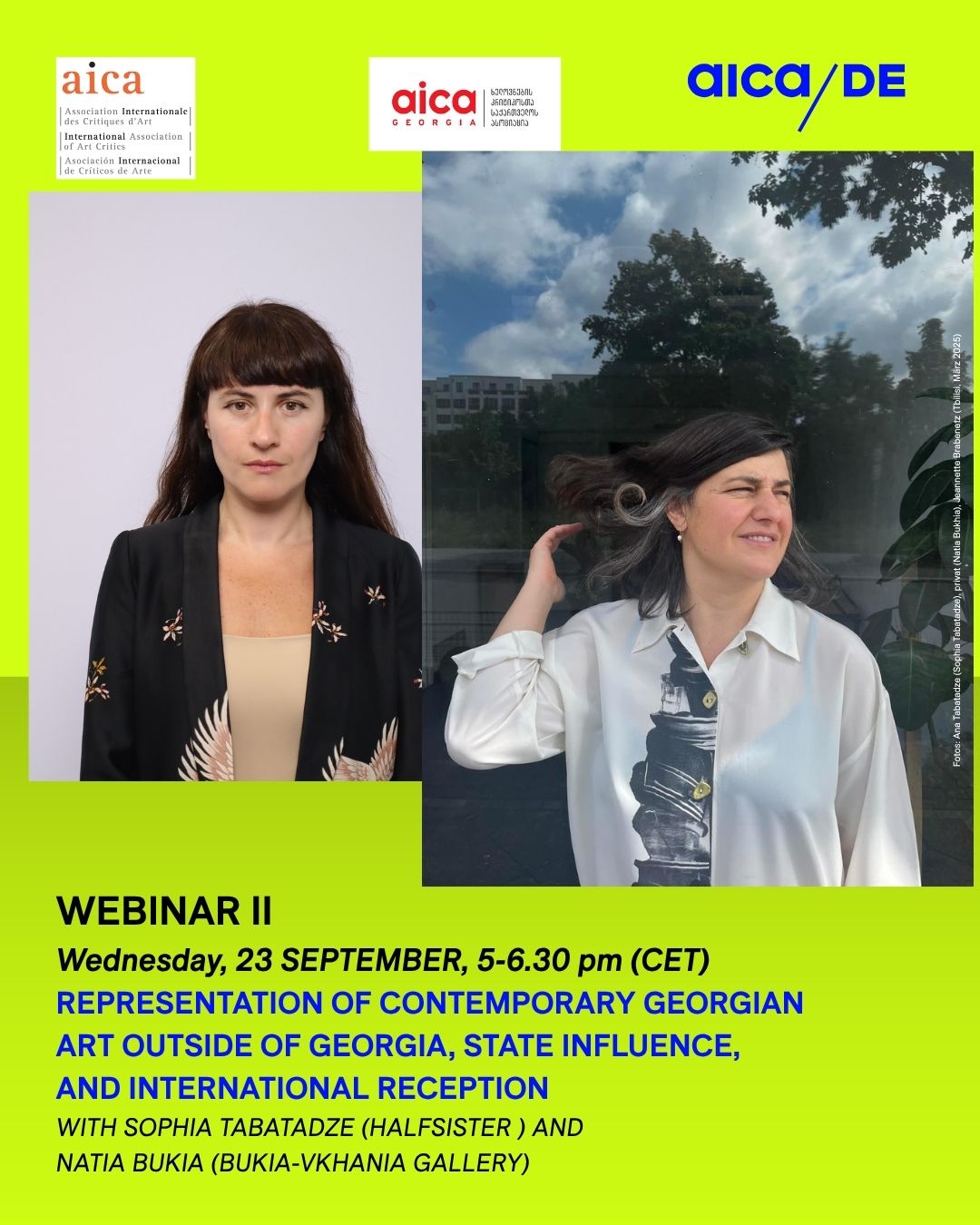
Webinar II – Representation of Contemporary Georgian Art outside of Georgia, State Influence, and International Reception
Wednesday, September 23, 2026 I 17:00–18:30 (CET, Tbilisi 19:00-20:30), registration required: vorstand@aica.de
Lecturers: Sophia Tabatadze (Halfsister Berlin) and Natia Bukia (Bukia-Vkhania Gallery Berlin, previously known as Artbeat, Tbilisi, Georgia)
Over the past decade, Georgia has experienced significant political and social transformations that have increasingly affected the country’s cultural environment. Political polarization, debates around Georgia’s European integration, civic mobilization, changes in cultural policy, and growing tensions between state institutions and parts of civil society have created a complex environment for cultural production and international cultural representation.
These developments have also influenced the position of contemporary art and the ways in which Georgian artists and cultural institutions are represented both within Georgia and internationally.
Contemporary Georgian art has frequently been presented to international audiences through the lens of the country’s political transition, post-Soviet experience, democratic aspirations, European orientation, and regional geopolitical position. While these contexts are important for understanding many artistic practices, they can also create particular expectations about what Georgian art should represent and how it should be interpreted.
At the same time, questions have emerged concerning the relationship between cultural institutions and the state, the role of public funding, institutional autonomy, cultural diplomacy, and the ability of artists and cultural professionals to maintain independent voices.
Recent political developments therefore raise important questions about who represents Georgian contemporary art internationally, which narratives become visible, and how political and institutional interests influence its reception abroad. The webinar will explore these questions through a conversation between Georgian and international artists, curators, researchers, and cultural professionals.
Sophia Tabatadze graduated from Gerrit Rietveld Academie, Amsterdam in 2002 and completed the CuratorLab curatorial program at Konstfack, Stockholm in 2018. Tabatadze’s drawings blend imaginary and real worlds, embracing the unpredictability of their outcomes. In 2007, she represented Georgia at the Venice Biennale and was also part of the Istanbul Biennale. Her work has been exhibited at the Wilhelm-Hack-Museum in Ludwigshafen; Tartu Kunstimuuseum; Musée des BeauxArts, Nantes; Museum Boijmans Van Beuningen, Rotterdam; and Tbilisi History Museum. Halfsister primarily organizes exhibitions and film screenings, but has also accommodated readings, stand-up performances, book launches, and pop-up markets. With two of the studios being used by artists from Georgia, Halfsister has established a network of Georgian cultural professionals and uses the space to showcase Georgian art while raising awareness of the ongoing democratic struggles in Georgia.
Natia Bukia is a Georgian gallerist, curator, and cultural practitioner with over a decade of experience in contemporary art, curating exhibitions across Tbilisi and Berlin. She graduated from the University of Westminster in 2007 and received an MBA with Distinction from London Business School in 2011. In 2014, she co-founded Moving Gallery, a mobile exhibition platform presenting site-specific projects across Georgia and bringing contemporary art beyond established cultural institutions. Three years later, the project established a permanent space in Tbilisi and became Gallery Artbeat. In 2026, Bukia co-founded Bukia Vakhania, extending the gallery’s presence to Berlin and opening a new phase in its international programme. Her practice combines long-term engagement with artists and an ongoing commitment to international exchange. In 2019, she co-organised the Georgian Pavilion at the 58th Venice Biennale. Under her co-leadership, the gallery has participated in major international platforms including Art Basel, Frieze London, Paris Internationale, NADA Miami, ARCOmadrid, Basel Social Club, and Art Collaboration Kyoto. Her work focuses on supporting emerging and mid-career Georgian artists over time and strengthening their international presence through exhibitions, institutional partnerships, and cultural exchange.